Monday, September 23, 2013

Checkpoint #3: Reading Skills

Sometimes, you have to look past realism, and believe what you see. When You Reach Me by Rebecca Stead is a science-fiction book set in the 1970s. It's about a young girl who witnesses her best friend get beat up, and how it completely changed her entire life. I am only on page 96 currently, but the book is extremely enticing and I can't wait to get home and read more.

Predictions

So far, the main character, Miranda, has witnessed her best friend, Sal, get beat up for apparently no reason, and has suddenly stopped being friends with her. She makes a new friend, and discovers that her new friend has epilepsy. Miranda meets the person who beat up her best friend and discovers he is a genius. (Marcus). She also receives two notes from someone who is apparently from the future. This book is sci-fi, so I found it an appropriate book to make predictions about.

My first prediction about the book is her friend will probably suffer an epilepsy attack sometime soon, which will affect Miranda negatively. I predict this because in the text I read:
 "She was quiet.
"It's not a big deal, just that Julia said-"
"No," she interrupted. "It is sort of a big deal. I should have told you. I have epilepsy-"
"Oh."
"-and I'm not supposed to eat bread or starches. It's this crazy diet my dad read about, but it actually works. I'm usually fine. People don't even really know I have it, because for years I've hardly had any seizures at all.'"

This quote is hinting that perhaps her friend will probably suffer a seizure sometime during the book, which will probably make Miranda question herself and her actions.

My second prediction is Marcus, the guy who beat up Sal, will do something much worse to Sal than beat him up again. I believe this because in the book I read: "I could have called out to Sal at that moment. It would have been easy. He would have had an excuse to turn around and start walking away from Marcus. And then Marcus might have stopped to talk to me for a minute, and Sal would have seen that it was all okay. He could have dropped his fear of Marcus right then and there. I've thought about this a lot, because I realize it would have changed everything that happened later."

From this quote I get the feeling that Marcus will bully Sal into doing something dangerous, or severely hurt him again. The part where it says, "I've thought about this a lot, because I realize it would have changed everything that happened later," is a huge foreshadowing moment. I believe Marcus will get Sal in trouble, or even kill him.

Questions

I don't read that many sci-fi novels. Much of the time and space talk confuses me. So I had a few questions about this book so far.

My first question is why did Marcus beat up Sal? The book says: "But just as we started past the garage, someone moved away from the group. He took a big step toward me and Sal and blocked our way so that we had to stop. I looked up and saw a not-too-biggish kid in a green army coat. He made a fist that came up like a wave and hit Sal right in the stomach. Hard." This quote tells me that Marcus, for no reason, suddenly hit Sal. Is there a background story between them? Is it about Miranda?

My second question is how the mysterious notes Miranda receives will play a part in the story. One of the notes was: "This is hard. Harder than I expected, even with your help. But I have been practicing, and my preparations go well. I am coming to save your friend's life, and my own. I ask two favors. First, you must write me a letter. Second, please remember to mention the location of your house key. This trip is a difficult one. I will not be myself when I reach you."

I am coming to save your friend's life, and my own. Sal's life? Who wrote the note? I think the writer is from the future, and the time traveling experience must change him, or make him physically/emotionally different so he wouldn't be able to tell Miranda himself. The letter part is especially confusing, because if Miranda must write a letter to someone from the future, how will she give it to him? Perhaps she must give it to a younger version of the writer. I am confused about how the writer will save Sal's life, so I will definitely read on and find out.

Connections

This text can be connected to the world because since the book is set in the 1960s, there is a lot of racism against African Americans. Miranda has a friend who is African American, and so I have read several racial slurs about her in the book. I have learned in history about how African Americans were treated poorly in the 60s, so I could really relate When You Reach Me to our world history.

This text can be connected to A Wrinkle in Time. The author of When You Reach Me actually makes A Wrinkle in Time Miranda's favorite book, because they both are so similar and the book plays a huge role in the novel. Miranda lives with a single parent, Meg lives with a single parent. Both books have time travel play a huge part, and When You Reach Me bases a lot of time travel theories and connections on A Wrinkle in Time. These two books can be connected so easily that you can't read one book without the other.

This text can be connected to myself because I know what it's like to lose a best friend, especially one you grow up with. Miranda and Sal were friends since diaperhood, and I had a friend like that. But as we grew older, we grew more and more apart and drifted away. Sal's and Miranda's friendship broke apart more abruptly, but I could still see myself in their relationship.

Monday, September 16, 2013

The Yearling

"Until one has loved an animal a part of one's soul remains unawakened." -Anatole France

The Yearling is treasured classic about a young boy who finds true friendship with a stag. There are so many themes and characters to analze that I found this a perfect book to analyze.

The main character in the story, Jody, lives in the dense woods of Louisiana with his mother and father. He has no pets or siblings, but his friend Fodder-wing is constantly awakening a longing in Jody's heart by having bears, raccoons, birds, and dogs as friends. Jody dreams about having a pet for his own, and one day he finds a fawn. He and the fawn become close friends but have to suffer through several hardships. In the end, the fawn and the boy do not live happily ever after together. This first quote describes the woods where Jody rambles and wanders in often. The author describes the scene so well that you can almost feel the fine mist from the rain, how soft the sand is, and how shady and cool it is underneath the green leaves. But at the same time, you can feel a certain omnious mood, as if the author is hinting something important is coming, something bad.

"When he awakened, he thought he was in a place other than the branch bed. He was in another world, so that for an instant he thought he might still be dreaming. The sun was gone, and all the light and shadow. There were no black holes of live oaks, no glossy green of magnolia leaves, no patterns of gold lace where the sun had sifted through the branches of the wild cherry. The world was all a gentle gray, and he lay in a mist as fine as spray from a waterfall...A deer had come to the spring while he was sleeping. The fresh tracks came down the east bank and stopped at the water's edge..." (Rawlings 8).

I was transported into another world when I read this quote. Majorie Kinnan Rawlings is such a master at using descriptive words and sensory details. The novel is a very sad but beautiful book, and this quote really shows me that although the woods are gorgeous, they are hiding very dark secrets that can tear apart the bond between a boy and his deer. The text is explicitly stating that the woods had changed from being a beautiful and peaceful place to an entirely different world. Especially when it says: "The sun was gone, and all the light and shadow." This line takes away the serene feeling of relaxing in the woods and instead creates a very foreboding feeling. The deer tracks hint that Jody will soon find the fawn and befriend it, but their story will not end well.

"The sun was not far from its setting when the long-leaf pines around the Baxter clearing came into sight. They stood tall and dark against the red-gold west. He heard the chickens clucking and quarreling and knew they had just been fed. He turned into the clearing. The weathered gray of the split-rail fence was luminous in the rich spring light. Smoke curled thickly from the stick-and-clay chimney. Supper would be ready on the hearth and hot bread baking in the Dutch oven" (Rawlings 10).

Though this quote doesn't hold the quiet charm of the forest, the Baxter farm's homelike feel and warmth is very apparent through this description of the home. The way the author describes the home gives you a sense of peacefulness and stability, the safe haven from any danger. In the book, Jody is constantly bringing the fawn into the house during storms or wild animal attacks, so the house is a safe place for both Jody and his friend. The Baxter farm is the place where Jody grows up with the deer, and by just reading the quote I could tell that this was a place where he would have many fond memories with the fawn.

I could go on and on about Mrs. Rawling's masterful use of descriptive details. I could fill this page with excerpts from her novel to describe and analyze. Every quote has a hidden meaning behind it, so this is one of those books that you can really pick apart and digest thorougly.


Tuesday, September 10, 2013

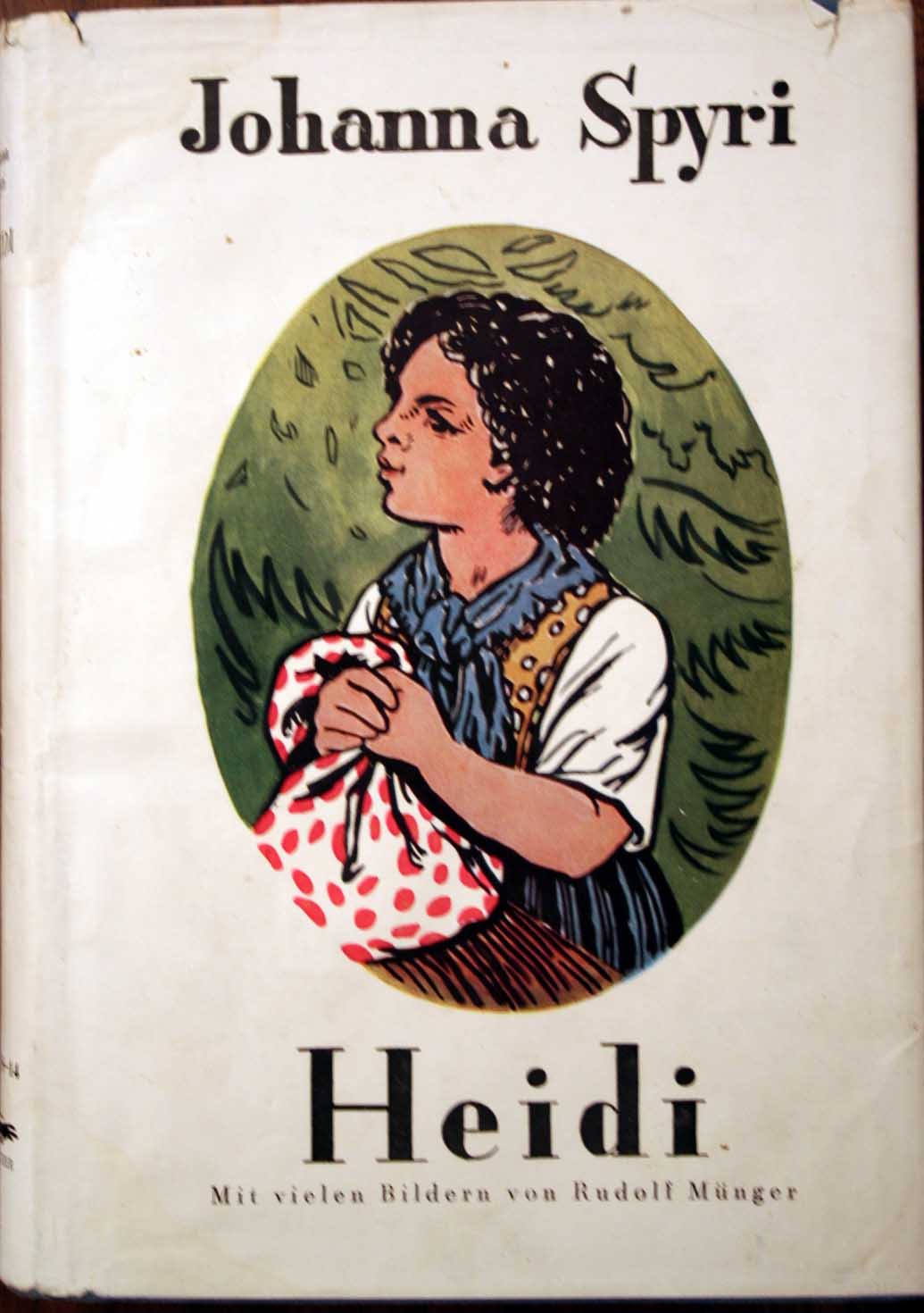
Heidi

     I am currently reading the novel Heidi, by Johanna Spyri. The reason I am reading it is because I am trying to improve my knowledge of classics, and Heidi is a very famous classic. It is about a young girl who goes and lives with her 'harsh' and 'mean' grandfather in the mountains. Heidi immediately falls in love with the mountains and her uncle, who proves to be a very kind and loving person. But later in the story. Heidi gets taken away back to the city, where she hates being penned up in and starts sleepwalking and becomes ill. This is as far as I have gotten so far.

     So far, I have enjoyed this book. The author's descriptive of the setting is very detailed and beautiful. "She stared joyfully at the mountains. During the night the wind had blown away all the clouds; the dark blue sky was spreading overhead, and in its midst was the bright sun shining down on the green slopes of the mountain, where the flowers opened little blue and yellow cups, and looked up to him smiling" (Spyri 23).

      Heidi is a humorous character and I enjoy reading about her. The plot is very unique, and I have never read a book like this one. I would recommend it to teens or children with advanced reading skills because although it seems like a childish book, the vocabulary is sometimdial officials and a child would find it hard to understand. For example: "She was surprised at what she had been told about Heidi's incapacity for learning, and determined to find out more concerning this matter, not by inquiries from the tutor, however, although she esteemed him highly for his uprightness of character; she had always a friendly greeting for him, but always avoided being drawn into conversation with him, for she found his style of talk somewhat wearisome" (Spyri 97).

 The only complaint I have about the story so far is sometimes the characters are too flat or static. I am excitd to see how the story ends
Here is another review of the novel Heidi.